dinsdag 28 juni 2011

NPD-ers aangepakt

[B] 4 NPD-Funktionäre in 4 Tagen angegriffen

serial mum 26.06.2011 14:58 Themen: Antifa
Antifa schlägt zu. Neonazis schäumen. Polizei tappt offenbar im Dunkeln. Mit dem Landesvorsitzenden Uwe Meenen, dem Kreisverbands-Chef von Neukölln Sebastian Thom und dem Neuköllner BVV-Abgeordneten Jan Sturm bezogen hochrangige Funktionäre der Berliner NPD in den letzten Tagen eine Tracht Prügel. Sie sind zudem auf den vordersten Listenplätzen der NPD bei den kommenden Wahlen im September. Die TäterInnen entkamen in allen Fällen unerkannt.
Die Fakten

Jan Sturm (Mittwoch/ Donnerstag)
In der Nacht von Mittwoch auf Donnerstag wurde Jan Sturm Ziel eines Angriffs. Laut Polizei hatten fünf vermummte und komplett schwarz gekleidete Personen den 46-Jährigen gegen 23 Uhr 15 in der Richardstraße nahe seiner Wohnung zunächst vom Fahrrad gestoßen und anschließend mit Stöcken auf ihn eingeprügelt. Welt-Online wusste zu berichten, dass Sturm hierbei als "Nazi" beleidigt(!) wurde. Sturm erlitt laut der extrem rechten Jungen Freiheit "multiple Platzwunden und zahlreiche schwere Prellungen". Er hatte der Polizei zunächst mitgeteilt, selbst einen Arzt aufsuchen zu wollen. Zeugen beobachteten den Vorfall. Die Polizei nahm Ermittlungen wegen gefährlicher Körperverletzung und Beleidigung auf.

NPD-Wahlhelfer in Friedenau (Freitag)
Ein Wahlhelfer der NPD wurde Freitag Mittag in Friedenau von einem einzelnen Unbekannten angegriffen und seiner Wahlunterlagen beraubt. Der Mann beleidigte den 56-Jährigen laut Polizei gegen 12 Uhr in der Lauterstraße, riss ihm anschließend sein Unterschriftenbrett mit den Unterlagen aus den Händen und flüchtete über die Schmargendorfer Straße in unbekannte Richtung. Der NPDler wurde nicht verletzt.

Sebastian Thom (Samstag)
Am Samstag Vormittag wurde gegen 10 Uhr 30 dann Sebastian Thom im Horst-Caspar-Steig (Gropiusstadt) beim Verteilen von NPD-Wahlflyern niedergeschlagen. Als er am Boden lag, sollen die fünf bis sechs mit Sonnenbrillen und schwarzen Tüchern vermummten Täter - laut Polizei - so lange auf Thom eingeprügelt und getreten haben, bis sich Anwohner beschwerten. Der 24-Jährige erlitt Prellungen und Schürfwunden. Die Täter sollen schließlich einen Beutel mit Wahlpropaganda der NPD mitgenommen haben.

Uwe Meenen (Samstag)
Ebenfalls am Samstag traf es dann den Landeschef der NPD. Uwe Meenen war laut Polizei auf dem Weg zu einer NPD-Veranstaltung im Rathaus Treptow, als ihn fünf vermummte Angreifer darunter eine Frau gegen 12:30 auf der Bösebrücke am S-Bahnhof Bornholmer Straße in Prenzlauer Berg von hinten attackierten und ihm Schläge in den Nacken versetzten. Als er zu Boden ging, sei er getreten worden. Die Täter entwendeten zudem ein Buch [?] und sprühten ihrem Opfer Reizgas in die Augen. Meenen erlitt Prellungen und wurde in einer Klinik ambulant versorgt. Er verpasste daher als Landeschef die Vorstellung des Landeswahlprogramms seiner Partei.

...to be continued?


Reaktionen der Neonazis

Bereits nach der ersten Attacke übertrafen sich verschiedene NPDler mit haarsträubenden Übertreibungen und (versteckten) Drohungen. Jan Sturm selbst sah sich als Opfer eines "Mordanschlags", den er nur knapp überlebt habe. Sein Beleg: die ihm zufolge 8 TäterInnen führten Waffen, wie "Rund- bzw. Kanthölzer" mit sich, als sie ihm den Hinterhalt legten und ihn von seinem "Bergfahrrad" (= Mountainbike) rissen. Sein Parteikollege Stefan Lux stimmte ähnlich schrille Töne an und keifte im Internet von "anarchobolschewistischen Linksextremisten", die für ihren "Mordanschlag" eine "kriminelle oder gar eine terroristische Vereinigung" gebildet hätten. Der NPD-Bundeschef Udo Voigt rief öffentlich zur "Bildung von Schutzmannschaften" auf. Selbst in Neonazi-Internetforen mehrten sich dann aber schnell die Stimmen, die in dem Angriff nur eine "Lektion" für Jan Sturm erkannt haben wollen, bei der selbstverständlich keine Tötungsabsicht vorgelegen habe. Von Jan Sturm ist bekannt, dass er sich in der Vergangenheit oft vor seinen "Kameraden" und teilweise auch vor der Öffentlichkeit damit brüstete, schon mehrfach - angeblich in Notwehr - politische Gegner geschlagen zu haben.

Auch Sebastian Thom sah sich laut einer Darstellung auf einem Neonazi-Infoportal mit "8 linksterroristischen Auftragsmördern des Systems" konfrontiert, wobei er sich "nur leicht verletzt [...] absetzen" konnte. Thom war in den vergangenen Jahren mit einer Vielzahl von Übergriffen aufgefallen. Unter anderem beschoss er 2006 einen Stand der Partei "Die Linke" in Rudow mit Signalmunition. Zudem attakierte er in Rudow erfolglos einen Polizisten, der ihn zu Neujahr in flagranti beim Hakenkreuze-Sprühen erwischt hatte. Für die Taten erhielt er ein mildes Urteil.

Eine sehr bemerkenswerte Reaktion auf den Angriff auf Uwe Meenen findet sich in einem bekannten Neonazi-Internetforum. Ein User veröfentlichte eine Nachricht aus dem internen Verteiler des "NW Berlin". Da sich die "Kette der feigen bolschewistischen Überfälle" weiter fortgesetzt habe und nun auch Meenen betroffen sei, gelte es, den "Terror der Roten" zu brechen. Es folgt der Hinweis: "Linke Lokalitäten sind auf der Berliner Widerstandsseite zu finden", angeschlossen mit der Auforderung: "Bewegt euren Arsch!". Meenen gilt als radikal und als selbst für einen heutigen NPD-Neonazi besonders antisemitisch. Er war vor einiger Zeit aus Bayern nach Berlin gekommen, um die Führung der Berliner NPD zu übernehmen. Unlängst hatte Meenen einen provokanten Wahlkampf für die Wahlen im September angekündigt, der bei Verzicht auf Bürgernähe in erster Linie vorhandene Sympathisant/innen ansprechen solle.


Spekulationen der Presse und über Kreuzberg

Während Spiegel-Online einigermassen an den Fakten orientiert von einer "Serie von Angriffen" schreibt und Neukölln als "gefährliches Pflaster für rechtsextreme Politiker" bezeichnet (und dabei Prenzlauer Berg (Meenen) vergisst), ergehen sich andere Medien bereits in weitergehenden Andeutungen und Spekulationen. So findet es "Endstation Rechts" "auffällig", dass es sich "jeweils um eine Gruppe von fünf bis sechs Personen gehandelt hat, die zudem immer dunkel gekleidet und vermummt auftraten". Es habe sich um "geplante Aktionen" gehandelt, womit offenbar von "Endstation Rechts" eine Serientäter-These in den Raum gestellt werden soll. Charmant klingt das, dürfte aber wahrscheinlich an der Realität vorbeigehen.

Eine Verbindung zum verhinderten Neonazi-Aufmarsch in Kreuzberg am 14.05.11, bei dem ein Dutzend Neonazis auf 4 sitzende Gegendemonstrant/innen eintraten, wird bislang nur vereinzelt von den Neonazis in ihren Internetforen gezogen. In Medienbeiträgen war damals immerhin spekuliert worden, dass die Kreuzberger/innen zur in den Medien "Selbstjustiz" genannten antifaschistischen Selbsthilfe greifen könnten, da das Vertrauen in die Polizei auf einem neuerlichen Tiefpunkt angelangt sei. Die Demo war von Neonazis und Polizei gemeinsam und heimlich vorbereitet worden. Eine Strafverfolgung gegenüber den Neonazis war bzw. ist nicht erkennbar.
Der NPD-Landesvize Sebastian Schmidtke hatte die Demonstration angemeldet. Sebastian Thom übernahm organisatorische Funktionen und auch Jan Sturm war im Lautsprecherwagen vor Ort. Im Nachhinein verhöhnte Sturm die Opfer der Neonazi-Attacken, indem er in einer "Richtigstellung" auf den NPD Webseiten behauptete, die Neonazischläger hätten sich gegenüber den Sitzenden "in einer Notwehrlage" befunden. Und: "die Demonstranten [=Nazis] begannen selbst die Wegstrecke zu räumen", weil die Polizei angeblich "keine Anstalten machte, gegen die ersten Blockierer vorzugehen". Auch Meenen stellte sich im nachhinein öffentlich hinter die Demoanmeldung seines Vize, dem seiner Ansicht nach "nichts vorzuwerfen" sei.

Ob die Verbindung zwischen Kreuzberg und den Aktionen aber tatsächlich zu ziehen ist, ist vorläufig so unklar wie die Frage, ob weitere Aktionen dieser Art in den nächsten Tagen zu erwarten sind.
Eine Botschaft dieser Denkzettel an die Neonazis dürfte hingegen glasklar sein: Wer auch immer denkt, er habe als Nazi eine Perspektive im Parlament oder auf der Strasse, muss mit ernsten Konsequenzen rechnen. Das dürfte auch bei den jüngeren, noch unbedeutenden Neonazis ankommen. So manch einer wird sich fragen: Wer wird der nächste sein? Und das unangeneme aber richtige Gefühl im Bauch, dass es immer und überall passieren kann, schränkt den politischen und persönlichen Spielraum ein und zehrt an den Nerven, demoralisiert und macht das Nazisein unattrakiver. Das ist wohl in jedem Fall ein positiver Effekt.


NPD-Demoversuch in Kreuzberg
http://antifa-berlin.de/fight-back/kreuzberg.html
http://antifa-berlin.de/fight-back/know.htm

Presselinks (unvollständig):
http://www.spiegel.de/politik/deutschland/0,1518,770580,00.html
http://endstation-rechts.de/index.php?option=com_k2&view=item&id=6306:uwe-meenen&Itemid=387
http://www.tagesspiegel.de/berlin/polizei-justiz/npd-landeschef-von-vermummten-niedergeschlagen/4324324.html
http://www.morgenpost.de/berlin/polizeibericht/article1682512/Erneut-NPD-Abgeordnetenhaus-Kandidat-verpruegelt.html

Polizei-Pressemitteilungen:
Uwe Meenen: http://www.berlin.de/polizei/presse-fahndung/archiv/349273/index.html
Sebastian Thom: http://www.berlin.de/polizei/presse-fahndung/archiv/349249/index.html
Jan Sturm: http://www.berlin.de/polizei/presse-fahndung/archiv/348998/index.html
NPD-Wahlhelfer: http://www.berlin.de/polizei/presse-fahndung/archiv/349164/index.html

Casa Pound and the New Radical Right in Italy


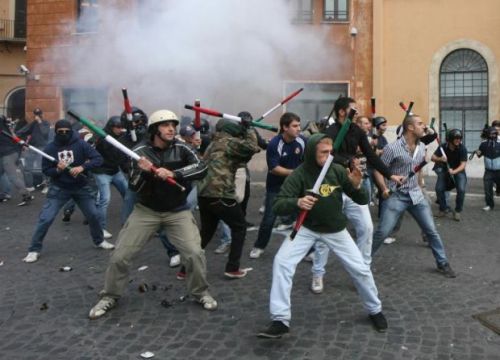
tBlocco Studentesco during scuffles in Piazza Navona, Rome, 2008.

You'd be forgiven for thinking that a group of zine-publishing techie squatters into rock music, baiting the state and defending the working class were part of the anarchist left. But, writes the Moyote Project, Italy's Casa Pound movement is symptomatic of the radical right's growing ability to assimilate progressive agendas into a toxic and populist political brew.

In 1973 the Italian neo-fascist group Nuova Destra (New Right) started publishing the DIY fanzine The Voice from the Sewer, as an ironic response to the left-wing slogan that incited (neo)fascists to return to the only place that they possibly could have emerged from. Yet now, more than 25 years on, it appears as if the fragmented, contradictory and unrepentant universe of the Italian radical right has crawled out of the sewer and entered the public sphere with its head held high. Armed with new tactics, a rousing new vocabulary and a rehash of old ideologies - and making use of the latest in graphic design - it has carved out for itself a space which is precariously balanced between the street and the various state institutions and are achieving pernicious success in both arenas. It labels itself the non-conforme right and ‘third millennium fascists'1. Its recent successes and new found abilities in interpreting the moods and swings of our times suggest that its recent, surprising re-emergence cannot be filed away as something symptomatic ,merely, of an appearance of detritus from the past. A closer look at its tactics, ideological baggage and at the role it plays in contemporary Italy is now more than warranted.

Casa Pound

Quote:
Casa Pound screams:

Man needs to be liberated.
The market kills the soul.
The law of profit sweeps away all obstructions that come in its way.
Workers, peoples, communities.
Love, joy, sacrifice and diversity. Destroyed.

- Casa Pound, ‘Who We Are'2

One of the most important and innovative configurations within the radical right galaxy is undoubtedly represented by the movement known by the name of Casa Pound (CP). Our choice to concentrate on this particular epiphenomenon stems from the fact that Casa Pound and its peculiar characteristics represent an important turning point in the Italian neo-fascist historical landscape. More fundamentally, an analysis of this particular social movement can act as a magnifying glass that will allow us to focus on the development of the radical right, the birth of a ‘plural right' and the political and social circumstances that favoured their contemporary rise in Italy.

Casa Pound was born in 2003 from the occupation of a state-owned building in the central and multicultural neighbourhood of Esquilino in Rome, by a group linked to the radical right milieu in the capital. The occupation was termed an OSA occupation (A Scopo Abitativo, ‘for living purposes'), in that a number of families were housed in the building. Besides being a residential squat, Casa Pound also became the base for the activities of the growing movement, and its symbolic locus. More occupations followed, some of them were OSAs and some were born as ONCs (Occupazioni Non Conformi - ‘occupations that do not conform'). The latter ones were conceived as social spaces that were to be open to the public, as spaces for the dissemination of culture, community and sports activities. This, we could observe, mimicked the function and style of left-wing social centres. Their main purpose has always been the creation of a sense of community, the strengthening of collective social ties and the forging of diverse connections within their specific localities. Casa Pound members were in effect reclaiming the normally left-wing activity of squatting and on their web site they announced: ‘the reactionary stereotype that defines the occupation of empty buildings as an exclusive practice of the left is forever shattered.'3

And thus, after establishing itself and taking root in the capital, CP developed as a national organisation and then proceeded to branch out into numerous cities in the country. It opened spaces (both occupied and not) and established for itself a growing platform for political manoeuvring. It now possesses significant political weight in Northern Italy throughout parts of that region which have been characterised by a strong right-wing tradition such as Verona and Milan. Nonetheless its presence in the South is also becoming very significant (Catania and Naples are just two cities where the CP's presence is substantial).

However, the first occupations in Rome have remained the most significant ones in terms of their duration and rootedness. One important characteristic of the ONCs is that they have emerged from a desire for a space of collective sociality and cultural production, rather than from an explicitly political and ideological drive. The musical scene that developed around the band ZetaZeroAlfa (ZZA) was absolutely central in this process, acting as a catalyst for the emergence of the movement. ZZA's lead singer and frontman is Casa Pound's charismatic leader, Gianluca Iannone. He has long been a major figure in the radical right political scene in Rome and is known to be close to names involved in the ‘black terrorism' season of the '70s. This musical scene has helped Casa Pound widen and strengthen its social base; it provides the important link between the subcultural dimension of a youth experience that finds its raison d'être in a generically rebellious and anti-conformist identity, and the experiences of a more ideologically defined political militancy.

The ‘metapolitical', or pre-political dimension connected to musical expression, to culture and to the development of a collective imagination, is key to CP's ability to fascinate and attract the attention of a growing number of young people. The ONCs host gigs, collective dinners, book presentations, cultural events; they organise mountain excursions and talks about ethnic minorities whose struggles garner popular support (Palestine has been one such example, but the Karen people have also been given attention). In Centri Sociali di Destra, Di Tullio says that,

The occupations of the radical right represent a new synthesis between metapolitical drives and a different approach to non-party politics; ones that are less unrealistically projected towards ideologies and closer to the everyday lived realities of the vast majority of people4.

Despite playing an absolutely key role in the constitution of new right-wing social formations, an appreciation for the metapolitical is nonetheless strongly supported by a political and ideological dimension that - behind the innovative communication strategies and the language used - is in direct relation to themes and issues typical of the anti-bourgeois and state-critical Social Right, the roots of which may be found in Mussolini's first theorisations and then re-emerging more explicitly in the experience of the Italian Social Republic of Salò (RSI, 1943-1945), as will be seen in more detail below.

The political issues that Casa Pound engages with through its educational events and political actions cohere around a few strong themes. These include the right to ownership of housing, struggles against the rising cost of living and the defence of the traditional family (which is understood as the basic unit of the nation). They have included the dissemination of revisionist theories, the critique of usury derived from the work of Ezra Pound and the study of historical and intellectual figures linked to or associated with the Social Right (such as Julius Evola, Alessandro Pavolini, and J.R.R. Tolkien)5. The range of intellectual influences also includes the recuperation of figures traditionally associated with left-wing culture with the most obvious example of this tendency being the appropriation of the work of Che Guevara. All of this is set against an ideological backdrop which is rife with anti-capitalist and anti-statist tendencies, which include the refusal of neoliberal worldviews and the defence of workers' rights (although understood to be limited to a nationalist frame of reference).

The main campaign on which CP has concentrated its efforts concerns the issue of the right to housing and the proposal for a ‘social mortgage'. Through direct actions coordinated at a national level, CP has tried to bring into existence a housing policy that would guarantee all ‘white' Italian workers the right to own a property. They have proposed a bill - which the coalition in power is in part considering implementing - that would guarantee access to a ‘social mortgage' for the purchase at cost price of a property managed by a public institution. The actions that have accompanied this campaign, which were of a symbolic and spectacular nature, have ranged from the hanging of mannequins to represent the Italian families strangled by mortgages, to an invasion of the Italian Big Brother set, which is seen as ‘an insult to all those Italians who are victims of the housing crisis'. CP's decision to use occupation as a tool has to be read in conjunction with this struggle for the ‘social mortgage', as an ideological stance and active political response to the difficulty of accessing affordable housing for a large section of the population. There has been a clear choice to concentrate on issues that have the potential to engage the poorest non-migrant sections of society and that have the potential to cary the most potent social charge. These choices represent a continuity in ideals with the tradition of the historical Social Right, but if they are seen in conjunction with the parallel attempt at obtaining political legitimacy, they should also be interpreted as symptoms of a fundamental break with the dynamics that the radical right has been part of since the post-war years. It is necessary to look at this historical conjuncture in a more detailed way so that we can appreciate the nature of the shifts now taking place in Italy.

Post-Fascism 1946-1995: Guaranteeing Order or Waiting for the Wind of Revolution?

The period we will take into consideration in order to summarise the history of neo-fascism - 1946-1995 - has been chosen because it represents the date of birth and of death of the main radical right-wing, Italian political party: the Movimento Sociale Italiano (MSI - Italian Social Movement). At the end of the Second World War, Italy, still lacerated by the bloody wounds of the fascist barbarity and the Nazi invasion, witnessed the formation of this collective political subject that positioned itself in radical continuity with the ideals of the defeated fascism. The MSI recuperated a so called ‘social version' of fascists, which had been incarnated in the Italian Social Republic of Salò. One of the main ideological reference points of this political strand was this republic's Verona Charter of 1943, which in its 18 points called for an absolutist fascist state to be founded on a corporatist model of labour relations where workers would have a stake in the profits of production, creating a cross class unity and a dissolution of class conflict. It championed land redistribution and a highly regulated version of private property relations permeated through and through by various anti-capitalist tendencies - whilst guaranteeing the individual's right to ownership of a private home.

The main objective of the MSI in the immediate post-war years was to offer a comprehensive ideological worldview and a refuge for all the defeated fascists who did not want to leave the ideals of the dictatorship behind. The party thus naturally became the central hub of the Italian far right, and local party offices opened their doors to different groups of camerati, despite the fact that in their midst a myriad of neo-fascist currents and groups developed. Some of these groups were extremely distant from and even in direct contradiction with official party lines. The post-war Italian landscape relegated fascists to a marginal and isolated position - although this was true more on a social than on a political level. And it was this fact that pushed so many right-wingers into embracing previously denigrated forms of what had once been thought to be specifically ‘radical forms' of political activism, as well as to engage in their own conspiratorial plots for coups and ‘revolutionary plans'.

It has to be pointed out that the internal and international dynamics of Italian political life of the post-war years were extremely complex: Italy was a member of NATO and occupied a strategic position on what might be described as a kind of European political chess board, and it was also home to the strongest and most organised Communist Party (PCI) in the western world. Many, and in particular the USA, had observed the internal Italian social and political situation with growing apprehension given the then international political uncertainty. In this condition of strong social tension and definite class polarisation, neo-fascism can be seen to have taken on a central and ambiguous role. The various groups (some of them armed and terrorist) were ferociously anti-communist and were to became the bloody executors of a strategy of tension that aimed to create chaos precisely in order to guarantee order. The intent was to provoke an anti-communist and authoritarian political strategy by carrying out acts of destabilisation (which were orchestrated in such a way that their political adversaries would be held responsible for them)6. Although these politics of dissimulation and deception were quite forcefully put into play, they were not lauded by some sectors of the radical neo-fascist scene who did not wish to be forced to go along with their prescribed role of being agents for both the Italian state apparatus, its intelligence service and their respective conspiratorial policies.

Although these groups did essentially agree with the strong anti-communist ideology of the Italian State and intelligence service, they also manifested their own anti-American worldview, embracing anti-imperialism and opposing themselves to the prevailing image of American society as paradigmatically individualistic and composed of a vast array of alienated subjects. This was theorised by Julius Evola, who became known as the neo-fascist ‘black baron'.

These currents started developing a practice of actions that would work against the system and not for its ultimate defence. One of the main formations that emerged was Terza Posizione (TP - Third Position), a name that refers to the incompatibility of their ideological worldview with both communism and capitalism, and was summarised in their slogan ‘neither red front, nor reaction'. TP configured itself as a ‘subversive' group holding to national-socialist and anti-bourgeois positions.

Terza Posizione's practices were influenced by the cultural and political climate of the time, and by a certain contradictory fascination with left-wing movements. This fascination had manifested itself since 1968 - with the presence, for example, of Nazi-Maoist and Guevaraist groups within the Law Faculty in Rome. The expulsion of the trade unionist Luciano Lama from the capital's Sapienza University had been admired by the neo-fascists who, while continuing with their attacks on ‘comrades' for the territorial conquest of the streets, had on more than one occasion pushed for an ‘overcoming of the differences' in an attempt to create a bipartisan convergence of the different-sided political factions against the real enemy: the State7.

One important aspect of all this is that - especially between the '60s and '80s - neo-fascist militancy was characterised by a strongly minoritarian and ghettoised social and political position, with groups entrenched in the MSI offices. One of the novel elements of groups like Terza Posizione was their determined attempt to leave the ghetto behind and become involved in the realm of social struggles. A seminal experience in this sense was TP's struggle in the working class and communist neighbourhood of Palamarola in Rome to support the regularisation of extra-legal housing erected by local residents8.

These centrifugal tendencies within MSI that have gravitated towards a ‘social and anti-statist neo-fascism', have clashed for years with much more pragmatic currents within the party - the ones that have envisaged institutional politics as the route to be taken towards a reconquest of the ‘unpresentability' of neo-fascist understanding and action. The statist current was the one that eventually lead the party to its dissolution in Fiuggi in 1995, and that became responsible for a new ‘post-fascism' that is incarnated in the ‘respectable' and ‘democratic' party Allenaza Nazionale (AN - National Alliance). The initial motivating desires and the radical tendencies of the previous social fascism are not erased in their recent emergence though. On the contrary, from that moment on, they have had to find other forms of expression. It is in the cultural and political climate of the last ten years that these tendencies have found fertile soil for their own rapid proliferation and for their frightening and often successful attempts to establish a national consensus that is germane to their very interests.

From the Right to the ‘Plural Right'

These more radical inclinations and tendencies have found a space to grow in the processes that led to the affirmation of a cultural hegemony of the right in Italy. Since the profound crisis of institutional politics - which erupted with the corruption inquests in the early '90s commonly known as Tangentopoli (literally, ‘Bribesville') - the right in Italy has experienced not only an overwhelming electoral success, but it is also said to have become culturally hegemonic in new ways. The ability to intercept and interpret the changing political, social and economic dynamics at play in the country and the imposition of an ubiquitous racist, identitarian and reactionary order of discourse as a way of explaining these dynamics, has been the foundation on which this hegemony has been built.

The capacity to understand the new subjectivities that have emerged out of the restructuring of the system of production over the last 20 years, and the construction of the category of the ‘illegal migrant', have been instrumental in this process. The fears that have grown among the working class as a result of widening social inequality and rising generalised insecurity have been given a voice. At the same time, the right has been able to harness the support of the new categories of workers that have emerged, specifically those that have been described as ‘second generation autonomous workers', an expression that refers to the growing class of precarious and flexible workers specific to the post-Fordist productive landscape9.

At the same time, the institutional right has undergone a process that led to its redefinition as a ‘plural right' - a synthesis was created that allowed different political cultures, which were at times openly at odds with each other, to coexist within the same coalition. According to Caldiron - one of the major analysts of the right in Italy - this process has taken place on two separate levels, one political and one cultural. On a political level this synthesis is incarnated in the figure of Berlusconi who has acted as a catalyst for the successful mediation between divergent tendencies within the right. Berlusconi's populist ability has been to bring into politics the particular and peculiar power of television to create dreams and lifestyles. On a cultural level the right can be said to have acted as an ‘entrepreneur of fear'. It has done so by determining all public debate and inscribing it within the categories of territory, identity and community. This is articulated and produced as a state of emergency, whilst the anxious refrain of the ‘migrant invasion' is constantly reiterated.

It is in this recomposition of the right that phenomena such as Casa Pound find space and legitimacy, albeit in an ambiguous fashion. In the cultural and political milieu defined as the ‘plural right' the traditional role of neo-fascist militant youth groups has mutated. They tend to adopt a strategy of entrismo, that is, they are given the possibility of gaining a certain degree of legitimacy and of influencing institutional matters whilst preserving their outsider status. In practice - and this is true especially at the local level - the relationships between the radical right and the right-wing parties in power are becoming closer. Representatives from groups of the radical right appear in the electoral lists of the ruling party, Popolo della Libertà (PdL - People's Freedom), the party that embodies the spirit of the ‘plural right'. Each side is, at times and in fractured ways, instrumental to the other: the radical right gains legitimacy and space for movement in the relation to other political parties - PdL but also Lega Nord (Northern League), the federalist party that seeks independence for the North of Italy. The ruling parties find Casa Pound's extreme stances useful to push the level of the political debate even further around social control, whilst at the same time widening their electoral and non-electoral reach. Nonetheless the relationship is and remains an ambiguous one, with no stable and univocal connections.

A paradigmatic case that exemplifies this complex relationship can be found in the recent revolt of Rosarno (Calabria), an event that dominated news headlines in January 2010. After the umpteenth episode of violence suffered at the hands of the local population, the migrant workers employed in Rosarno's orange harvest demonstrated and rioted against the inhumane treatment they are subjected to on a daily basis. The casus belli for the riot was the shooting and wounding of two migrant workers. The riot was followed by episodes reminiscent of a pogrom, with local Italian residents relentlessly attacking the migrant workers. The reaction to the events has been a generic condemnation of all ‘violence', where the shots fired at the migrants and the riots were made equivalent. The ‘social contradictions' that emerged from the events were minimised and reduced to public order and security issues. The ultimate responsibility for these contradictions was attributed to the migrants, who were once again criminalised and depicted as a new dangerous class.

In the days after the revolt, a Casa Pound delegation visited Rosarno to show its solidarity with the local Italian residents who had been accused of racism by the foreign press. The communiqué circulated by CP on this occasion expressed solidarity with the ‘indigenous' residents on the basis of their assumed ‘Italian-ness', whilst at the same time it asked for state intervention to punish the exploiters of the cheap and mostly foreign labour force. In the heated climate of those tense days, few other right-wing groups could have shifted the focus of the debate towards identitary positions, bordering on ‘blood and soil', in such an unabashed fashion, whilst at the same time managing to express their presumed proximity to the workers through the denunciation of the exploiters. The Government's response was to intervene with a heavy police presence, repression and mass deportations, whilst Berlusconi's official declarations presented the issues in a heavily racist frame in which illegal migration and criminality were equated.

One of the most controversial aspects of Casa Pound's ideology that emerges is their supposed ‘anti-capitalist' sentiment, based on a critique of workers' exploitation and of the commodification of all life, whilst at the same time proposing a corporatist model based on the collaboration between workers and bosses in the name of the supreme good of the nation. What remains to be considered is to what extent CP's actions can influence governmental decisions, and, more importantly, to what extent they are forging an attitude that is ‘rebellious' and that can be integrated in the novel and rampant common sense of the plural right.

Metapolitical Activism: Being ‘Third Millennium Fascists'

Quote:
Extraordinary action, when necessary.

Force the media to momentarily forget about the gossip, forget about the useless soporific chatter of the parliamentary class.

- Casa Pound, ‘Political Activity'10

One of Casa Pound's major accomplishments has been the ability to recompose the fragmented universe of the radical right. In the contemporary political and cultural context, where racist notions are largely tolerated and the identification with the nation to the exclusion of foreigners is endemic, CP has sought legitimacy at different levels, both on the ‘street' and in the world of media and politics, by putting itself forward as a credible interlocutor on social issues. Casa Pound members define themselves as ‘third millennium fascists', thereby underlining an ideal continuity with the past, and at the same time signalling their capacity to interpret and intervene in the present.

One of the challenges that Casa Pound has taken on has been to become an attractive collective subject for a universe of young right-wing activists involved in other groups or tired of the moderation of the mainstream party, Allenanza Nazionale. But it has also become a convergence point for many ‘street and stadium gangs' who are close to Nazi/skin groups and to right-wing football supporters11. Casa Pound has grown in numbers thanks to its attempts to project a radical image coupled with the attempt to gain political legitimacy. After much effort Casa Pound has gained a considerable following among high school students, particularly in Rome and Verona. This has led to the emergence of the Casa Pound student branch, Blocco Studentesco (BS - Student Block), an important reservoir of activists and supporters. The establishment of student groups in high schools has been an unachieved aim of the extreme right since the student movements of '68 and '77; so this success is notable.

The episode known as ‘the Piazza Navona clashes' is a clear example of how the strategy of searching for a parallel legitimisation is implemented. In October 2008, members of Blocco Studentesco attempted to place themselves at the head of a massive student demonstration in Piazza Navona, Rome. The slogan used on the day was ‘neither red nor black, only free thought', a slogan which contains an ideological legacy from Terza Posizione. A scuffle ensued, and the student demonstrators made an attempt at pushing the fascists out of the square. The reaction of the Blocco was organised and prompt. Armed with batons covered in Italian flags, they proceeded to defend themselves and attacked their adversaries. Subsequently Blocco Studentesco tried, with moderate success, to pass themselves off as the victim of barbaric anti-fascist aggression in the media's narrative of the events. What emerges is, on one side, the desire to project an image of the militants as courageous street warriors - an important symbolic message for both the militants and for their opponents. At the same time the events were clearly orchestrated in such a way that the media and the political world would condemn the ‘aggression' against Blocco Studentesco on the grounds of the student demonstrators' supposed ‘anti-fascist bias'. As the attempt to discredit anti-fascist history and action has been a long term project on the part of the entire right-wing spectrum, the Piazza Navona events also helped further this effort.

These events are also significant as they reveal the attention that CP pays to the media and the ability it has to use mainstream media mechanisms to its own advantage. Nonetheless it is in the sphere of self-produced media that more innovative approaches emerge. The political legitimation game and the effort to expand the consensus is thus not played out on the street alone. The investment into creating a cultural universe that could potentially have a profound impact is very strong. One online radio and one online TV station (Radio Bandiera Nera and Tortuga TV), two magazines, one regularly updated website and a myriad of satellite websites, are an impressive numbers of outlets for a movement such as CP, and they certainly reveal how important communication is considered to be. They also reveal a desire to project an image of a movement that is very much alive, that intervenes in contemporary events, that is active, and that comments and debates, as it did during the Rosarno crisis.

From a stylistic point of view, their media present a solid homogeneity and a carefully designed graphic aspect - capital letters strictly in Verdana font are coupled with intense but limited colours, red/black/white. The language used is vivid and engaging, and it is mainly based on slogans, incitements and abstract concepts rather than on articulated ideological positions, and at times it manifests an unexpectedly ironic streak. As mentioned above, music is absolutely central and helps in the creation of a common identity on which much of CP's appeal is based. One of their ideological pillars remains the cult of the fight, of physical confrontation and of the discipline of the body which, in conjunction with a rebellious approach and anti-conformism, attract younger activists. Many of the milieu's activities focus on the creation of a shared cultural and moral universe in which activists can invest the totality of their lives. The sense of the creation of a community is absolutely central. It is a community that recognises itself in a common identity, one based on a shared lifestyle, on an ethical model, in a national culture. In this sense CP is actively trying to create communitarian responses to drives and needs, both material and immaterial, that do not find answers elsewhere, such as the need for housing, social life, security and a collective identity.

We envisage that in the near future Casa Pound will develop from a movement to a more organised structure and will attempt to take part in electoral democracy as an independent entity. How this experiment will turn out is not of central importance nor does it concern us too deeply - what is of greater interest and what will leave a longer lasting legacy will have more to do with CP's creation of a permanent sense of fear and alarm, and its skill at providing solutions based on identitarian politics.

Moyote Project are Franco Berteni, Denis Giordano and Caterina Sartori. They spend their time between the deepest North Italian provinces, London and Paris. They manage to survive precariously by typing, researching, filming, sending pensioners to the tropics, serving drinks and answering the phone in no particular order.

  • 1. ‘Destra non conforme' is the term that the new radical right uses to define itself, in an attempt to distance itself from party politics and traditional neo-fascist ways of organising. Literally the term means ‘right that refuses to conform'. Since it does not translate well, we will use the term ‘radical right' throughout the article.
  • 2. See http://casapounditalia. org/index.php?option=com_content&view=category&id=35&Itemid=60 libcom admin: link broken to hostile website.
  • 3. Ibid.
  • 4. D. Di Tullio, Centri Sociali di Destra. Occupazioni e Culture Non Conformi, Rome: Castelvecchi, 2006, p.34.
  • 5. Tolkien has been historically appropriated by the right in Italy and inserted into its ideological pantheon.
  • 6. ‘Strategy of tension' refers to the co-ordinated attempt to destabilise the country through a series of terrorist massacres known as stragismo, the first episode of which was the bomb at Piazza Fontana on 12 December 1969, and continued with numerous bloody episodes, including the bomb at Bologna railway station on 2 August 1980. Despite the fact that the material responsibility of neo-fascists has been proven, these attacks remain largely unpunished and full light has not yet been shed on those who mandated them.
  • 7. The incident of Lama's expulsion occurred in Rome when, on 16 February 1977, the secretary of the trade union CGIL wanted to rally in the occupied university. The student movement and the ‘autonomia' had been critical of CGIL and PCI for some time, and saw the rally as a provocation. After scuffles between the union's security and the movement, Lama was famously chased out of the university by students.
  • 8. See G. Adolfi and R. Fiore, Noi Terza Posizione, Roma: Settimo Sigillo, 2000.
  • 9. See S. Bologna and A. Fumagalli, Lavoro Autonomo di Seconda Genrazione, Rome: Feltrinelli, 1997.
  • 10. http://casapounditalia .org/index.php?option=com_content&view=article&id=69&Itemid=90 libcom admin: link to hostile website broken.
  • 11. See V. Marchi, La Sindrome di Andy Capp. C

woensdag 13 oktober 2010

nat pak voor DeWinter

Aan de Gentse universiteit is het in de avond van 7 oktober tot rellen gekomen net voor de start van een debat waaraan Philip Dewinter (VB), Mark Demesmaeker (N-VA) en Jean-Marie Dedecker (LDD) zouden deelnemen. Actievoerders blokkeerden de toegang tot de gebouwen aan de Blandijnberg waardoor de organiserende 'Nationalistische Studentenvereniging' (NSV) zich genoodzaakt zag de gehele zaak af te gelasten. Door de blokkade was er immers geen doorkomen meer aan.

Net voor de start van de blokkade waartoe het 'progressieve studentenfront' had opgeroepen, slaagden een dertigtal NSV-leden erin om de gebouwen binnen te glippen. Een achtervolging annex vechtpartij later werden de extreem-rechtse studenten opgesloten in een auditorium op het gelijkvloers. Daar werden ze rond 20.30 uur ontzet door de politie. Onder de 'gevangenen' bevond zich NSV-vice praeses Wouter Opdenacker die naar eigen zeggen "bange momenten" had beleefd. Het kwam aan de ingang van het gebouw op de Blandijnberg tot schermutselingen toen Philip Dewinter, bijgestaan door een twintigtal Voorpost-militanten, waaronder de onvermijdelijke actieleider Lucien 'Luc' Vermeulen, de toegang probeerde af te dwingen met wapperende handjes. Dat lukte dus niet. Integendeel. De politie, een vijftigtal eenheden sterk, greep meteen in om de zaak niet verder te laten escaleren. Zelfs het waterkanon werd ingezet. Dat bezorgde VB-coryfee Dewinter een nat pak.

Voorpost-militant Luc De Corte (vooraan op foto 2, klik eenmaal op de foto voor een grotere afbeelding) hield aan het getrek en geduw een mediagenieke wonde aan het hoofd over die vandaag in zowat alle kranten te bewonderen valt. Het is niet de eerste maal dat De Corte, vroeger OCMW-raadslid voor het Vlaams Belang in Evergem, knokkenderwijs in de belangstelling komt. Vorig jaar raakte hij in de maand augustus - "door een samenloop van omstandigheden" - betrokken in een caféruzie en vechtpartij met enkele jongeren. Hierna stelde hij zijn mandaat ter beschikking en verliet hij naar eigen zeggen ook het Vlaams Belang. Lokaal VB-voorzitter en -gemeenteraadslid Alain Speeckaert had daarop aangedrongen. Speeckaert meende dat zijn slaaggrage collega de partij al te zware schade had toegebracht.

Het was de eerste keer dat de NSV de toelating had gekregen van de rector om een debat te organiseren in de gebouwen van de universiteit. Bij de trek- en duwpartijen raakte rector Van Cauwenberghe gewond en werd 'zwijmelend' afgevoerd. Ook al een primeur. NSV-praeses Arno D'Hooghe kondigde schuimbekkenderwijs een nieuw debat aan. Waarover en met wie verklapte hij wijselijk nog niet. Dewinter bekloeg zich na de incidenten over de aanslag op zijn vrije meningsuiting. De extreem-rechtse knokploeg zakte dan maar af naar de Overpoort zichzelf begeleidend met racistische slogans en 'nationalistische gezangen'. Er deden zich geen ongeregeldheden meer voor. Niemand werd gearresteerd. En zo werd het nog een gezellige avond.

Anti-fascist in prison in Bulgaria: Free Jock!

Deze nachtmerrie voor Jock Palfreeman loopt al enkele jaren, inmiddels was hij begin december 2009 tot 20 jaar veroordeeld en lopen er twee verschillende hoger beroepen door hem ingesteld. lees hieronder zijn verhaal en hoe je hem kan supporten ( Die Geschichte aufs Deutsch findest du auf dem Internationalen Webseite):

Jock Palfreeman is a 23 year old Australian who had the courage to stand up against 16 Nazis on a night out in Sofia, Bulgaria. He witnessed the fascists chasing and attacking two young Roma boys. Jock ran to the boys’ aid, he did his best to keep the Nazis at bay by waving a knife at them but they attacked him. Jock was left with nowhere to run and had no choice but to defend himself. Andrey Monov, one of the Nazis, was stabbed and killed and another, Antoan Zahariev was injured. The Roma boys ran away.

Jock has since been tried and sentenced for murder and attempted murder. He has been sentenced to 20 years imprisonment and has been fined 375,000 Australian dollars. Andey Monovs Father is well known in Bulgaria and at the funeral there were a mixture of judges, police and politicians.

Jocks trial was a complete sham – yet another example of corruption and secret hand shakes in the judicial system. The prosecutions case was built on the witness statements made by the other Nazis that were there that night, all claiming that Jock randomly attacked the group and chased them with the intent of killing somebody. Key people and possible witnesses were never interviewed by police and CCTV footage from the scene miraculously went missing and many of the statements made at the time were not the same as the statements submitted to the court by the prosecution. Jock has two appeals before his sentence becomes final.

We must campaign to free Jock and put pressure on Bulgarian authorities to accept his appeal. If his charges were downgraded to excessive use of force during self-defence, he would be already out. We must make sure that this judicial farce is highlighted and that they will not be able to repeat it again.

Latest news: in late May the senior judge in Jock’s case finally provided his written report on the reasons for the guilty verdict last December. It’s in Bulgarian of course! Jock’s defence team can now apply for an appeal hearing, which may take 6 months to be heard. In the meantime Jock has been stuck in isolation since 19 February and remains locked in a small room 23 hours per day, although ironically prison overcrowding means he shares with another prisoner. A couple of months later luckally he was moved back out of isolation. He can receive mail (letters only, no books etc), and visitors if you happen to be in the area. See on the bristolabc.wordpress previous reports on Jock.

Meer info vind je op; www.freejock.net en

http://bristolabc.wordpress.com/2010/06/12/campaign-to-free-jock-palfreeman/

AFA-Nijmegen zal een voorlichting geven over de English Defence League (EDL). De EDL is een Engelse extreem rechtse organisatie die zich bezig houd met anti-islam activisme. De EDL komt op 30 oktober naar Amsterdam voor een pro-Wilders demonstratie. Vanavond info over de EDL met woorden en filmpjes en info over de acties tegen de demonstratie van 30 oktober.

De Anarchistische Groep Nijmegen presenteert vanavond een infoavond over de Rozbrat in Poznan, Polen. De Rozbrat werd in 1994 gekraakt en is vandaag de dag een van de belangrijkste anarchistische-sociale centra waar vele intiatieven een plek vinden. Sinds 2009 wordt het pand bedreigt met ontruiming. Het Rozbrat collectief komt naar de Klinker, om te vertellen over hoe hun de strijd voeren tegen een mogelijke ontruiming en alles wat je wil weten over het runnen van een sociaal centrum!

Brigade M in Gouda?


Extreem rechts optreden in

Goudse popzaal

Vrijdag 15 oktober zal er in Goudse popzaal De Gonz een concert plaatsvinden van de bekendste Nederlandse extreem rechtse band Brigade M.

De extreem rechtse muziekgroep Brigade M (de M staat voor Mussert, de leider van de NSB) heeft een behoorlijke reputatie opgebouwd in de periode dat ze bestaan. Met nummers als “50000 helden”, een verwijzing naar de 50000 Nederlandse vrijwilligers bij de SS, en “eigen volk eerst” heeft Brigade M een behoorlijke status gekregen bij rechts extremisten door heel Europa. De leider van de band Tim Mudde is ook buiten de band om geen onbekend figuur binnen extreem rechts. Zo is hij actief geweest bij de verboden fascistische partij CP ’86 en is hij actieleider geweest bij de extreem rechtse actiegroep Voorpost. Door de status van Brigade M en Tim Mudde in de extreem rechtse wereld kunnen er veel mensen verwacht worden bij het optreden aanstaande vrijdag. Eerdere concerten van extreem rechtse bands in Nederland liepen dikwijls uit op vechtpartijen en ordeverstoringen. Om uit het zicht van overheid en politiek te ontsnappen heeft Brigade M voor dit specifieke optreden de schuilnaam “Heilige Oorlog” aangenomen, een veelgebruikte tactiek bij extreem rechtse concerten.

Het concert staat niet op de site van De Gonz en daarmee wordt de illusie gewekt dat het om een besloten feest gaat. Niets is echter minder waar, via diverse extreem rechtse mailinglijsten en internetfora wordt er opgeroepen om naar de muziekavond te komen. “Het is belachelijk dat een popzaal als De Gonz meewerkt aan het promoten van extreem rechtse muziek. Racisme en verheerlijking van het derde rijk zijn aan de orde van de dag in de teksten van de band die in De Gonz op zal treden” aldus een woordvoerder van AFA. “Wij roepen De Gonz hierbij dan ook op om de stekker uit dit racistische optreden te trekken”.

Voor meer informatie over Brigade M kijk bij onderstaande links
http://www.xs4all.nl/~afa/alert/1_9/brigade.html
http://www.doorbraak.eu/gebladerte/10776f48.htm

Nazidemo 23 oktober Hamm


Op 23 oktober roepen nationaalsocialisten uit Hamm op tot een demonstratie onder het motto “Das System bringt uns den Volkstod! - Freie Völker statt freie Grenzen!”( Het systeem zorgt voor volkerenmoord! _Vrije volken in plaats van open grenzen!)

In de oproep voor de de demonstratie word onder andere het 'nationale socialisme' als 'natuurwet' neergezet en zal de overname van de macht zeer binnenkort plaatsvinden.

De sprekerslijst bevat zo'n beetje het hele rechts-extreme spectrum. Naast de immer aanwezige Axel Reitz ( de.wikipedia.org/wiki/Axel_Reitz ) en Christian Worch ( de.wikipedia.org/wiki/Christian_Worch ), zullen onder andere Hartmut Wostupatsch ( de.wikipedia.org/wiki/Wostupatsch ) en Sven Skoda spreken.

Axel Reitz was lid van de “Kampfbund Deutscher Sozialisten” ( de.wikipedia.org/.../Kampfbund_Deutscher_Sozialisten ). Hij is meerde malen wegens Jodenhaat, het dragen van verboden symbolen en overtreding van het uniformverbod veroordeeld. Ook de andere sprekers zijn sinds lange tijd actief binnen de rechtse scene en zijn meerdere malen opgevallen door veroordelingen wegens smaad en Jodenhaat


De Kameradschaft Hamm beschikt, zoals uit de sprekerslijst blijkt, over talrijke contacten in Nordrhein-Westfalen en verder. De Kameradschaft Hamm werkt intensief samen met neonazi's uit Dortmund ( de.wikipedia.org/wiki/Autonome_Nationalisten ), Ahlen, Unna en Münster. Er worden regelmatig acties en demonstraties gezamenlijk georganiseerd. Een voorbeeld van de samenwerking tussen Ahlener en Hammer nazi's is de demonstratie op 22 oktober 2010 in Ahlen op de vooravond van de demonstratie in Hamm.


Ook dit jaar kwam het in Hamm weer tot aanvallen/intimidatiepogingen op antifascistische evenementen en politieke tegenstanders. Ook word er opgeroepen tot moord op Joden en antifaschisten, word het nationaalsocialisme verheerlijkt en zijn er bekladdingen met hakenkruisen


In Hamm word de actieve neonazi-scene nog steeds weggezet als minimaal. En als teken van afkeur word het neerlaten van jaloezieën en het buitenzetten van de bruine kliko's voor gesteld. Wij willen ons daar niet bij neer leggen en roepen alle antifaschisten uit de regio en daarbuiten op, naar Hamm te komen en actie te ondernemen.

Welke actie-mogelijkheden er zijn vinden jullie op http://aah.noblogs.org